Thursday, October 7, 2010

Labor Day by Joyce Maynard

I had no idea who Joyce Maynard was until the winter of 1999, when I read At Home in the World, her memoir. That book garnered much attention in a negative way-Maynard revealed a very personal story (her own experience, mind you) involving JD Salinger. The two shared a relationship, which profoundly affected her (as a writer and a woman), when she was 18. Salinger, notoriously reclusive, instigated the relationship, and it was far from idyllic. Once Maynard revealed portions of his life, she was very publicly castrated from the literary world's good graces. In doing so, I fell in love with her.

This is only the second piece of Maynard's fiction that I've read, and I will definitely be looking for more.

Henry is a 13 year old boy, living in the tension of a split family. His relationship with his mother is close, bordering on inappropriate. He senses this, but has no vocabulary for describing his mother's emotional frailty. Here we find him coming to terms with this, as well as his distanced relationship with his father and new step-family.

Over Labor Day weekend-six short days -we see Henry discover pieces of what he's been missing. A stranger approaches during a rare shopping trip and asks for Henry's help. This stranger is Frank. Frank enters Henry's home and shows him a new idea of family, of being there for one another, of normalcy. In the most abnormal way.

I loved every awkward moment that Henry experiences through learning what every child should-love is love, regardless of how it appears to the outsider.

When You Reach Me by Rebecca Stead

Miranda is an adolescent girl living and attending public school in New York City. Her best friend, Sal, lives in her building, and it seems as if neither of them has travelled far from what they know. There's the crazy homeless man that sleeps under the mailbox on the corner, the sandwich shop that they "work" in during their lunch break, and the gang of ruffians that terrorize passersby in front of the garage...all within a 3 block radius of their apartments. Without seeming to try too hard, Stead creates a world that I could easily visualize as a film.

Weird things start happening. Miranda receives eery handwritten notes that reference events that haven't occurred...yet. When they start to realize, Miranda attempts to figure out the mystery. With catchy chapter titles that always begin with, "Things That...," one of the boys from the garage presents himself more frequently into Miranda's everyday life. Our girl's favorite book, A Wrinkle in Time, plays part and parcel to some clues as to what's going on with the notes. Perhaps it's my disdain for physics, or the reminiscence of past conversations with Gabe, Steve, and Todd that never produced exceptional fruit or clarity about the nature of time and its' continuum, but I didn't give much thought to the larger message.

Either way, I was entertained for an afternoon whilst floating in the pool in GBG.

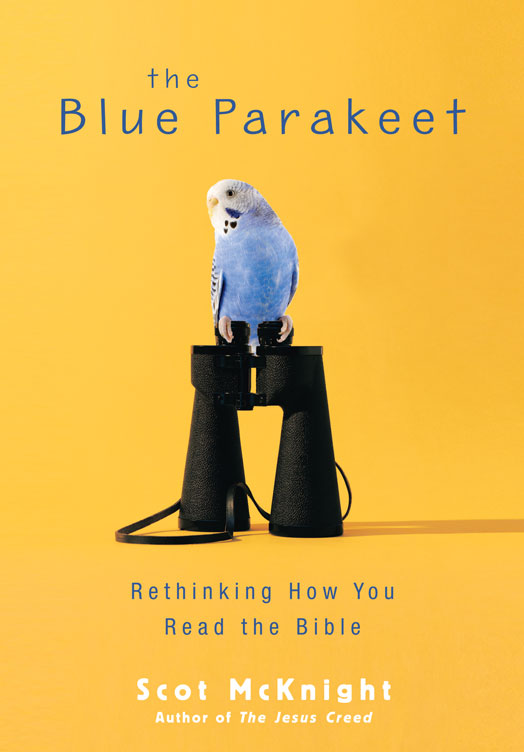
The Blue Parakeet by Scot McKnight


Lest I be my
snarky self when it comes to "Christian" writings, I'm pasting the Publishers' Weekly review from Amazon here:

"Infused with common sense and seasoned with candor, the latest work from McKnight (The Jesus Creed), religious studies professor at North Park College, takes a stand in controversial territory by bravely asking the question: how is it that even Christians who claim to be led by an authoritative Bible read it so differently? In response, the author asserts that believers need to take a fresh look at how they adopt and adapt Scripture before they can read the Bible in a way that renews a living relationship with the God behind the sacred text. Using the analogy of a water slide, McKnight argues that the Gospel is the slide, the Bible and church tradition the walls that both protect and liberate the believer as he or she discerns how to apply Scripture as a living document. In the last section, McKnight tackles the controversial issue of women's role in church ministry in a way that is both scholarly and confessional, documenting his own journey alongside that of the apostle Paul and other biblical characters. Enriched by folksy anecdotes, this volume could be very useful for evangelical readers and any others wanting a safe place to ask the same bold questions."

Given my love of discussion, this was an experiment in pushing myself to read things that I've not as of late. A group of 5 embarked upon a book club of sorts for this one, and we read it over the course of 4 months. The group included 2 of my closest friends, one newer acquaintance, and one of my roommates at the time. It should be mentioned that 4 of us had at one time or another been on staff or volunteered for the same youth program at a church that we were all still at least loosely affiliated. Always for adding another layer to relationships and thinking, I was excited to enter into this endeavor.

This situation allowed for many questions to be entertained, and many long held assumptions to be challenged. There were many moments of discord, and Scot-with-one-t held his own while withholding his blunt opinions to the point of never really knowing what he was urging you to think. While that sounds gracious enough, it was hard to walk away with anything more than a swirl of unanswered questions. However, it did open up the ground for analyzing things with a fresh perspective.


Wednesday, October 6, 2010

Short Stories...by Raymond Carver, Dorothy Parker, David Foster Wallace, John Updike


There are a few short story collections sprinkling my book collection, but I very rarely commit myself to reading them. They are generally filler, picked up between books and before bedtime when I'm in need of a distraction or my senses need to be dulled towards sleep.
Raymond Carver, however, is an exception. Carver has the ability to captivate me. His ability to turn everyday life into a grandiose experience calls to grab a cup of hot tea and settle in. Which is what I did, multiple nights in a row.
That led to turning to other old favorites...perhaps stories shall be turning up on my list more frequently.


Olive Kitteridge by Elizabeth Strout


What to say about Olive? Here we have a character who isn't very likable, nor sympathetic, but I found myself identifying with her, liking her, and having a great deal of empathy for her. Her life, her situations, her surroundings.

Strout tells the tale of Olive Kitteridge using vignettes, each chapter sketches a story that, while building part of a larger whole, can stand alone. While I doubted it's effectiveness (and was quite irritated) when I realized that Chapter Two wasn't necessarily connected to the first, I quickly became engaged with each portion of the book. To the point of being riveted. I journaled about this book. I read it aloud to both of my roommates (two separate passages at two separate times), and we had heartfelt and meaningful discussions as a result.

Olive and the people who populate the town of Crosby, Maine live very mundane and commonplace small-town lives. It's just that that makes their experience, and this book, remarkable.

Friday, September 17, 2010

Bright Shiny Morning by James Frey

I unabashedly love James Frey. Regardless of the is-memoir-is-it-fiction argument (which I'm not addressing here), this guy can write. I received Million Little Pieces as a galley when I lived in Chicago, and had already read (and cried over) My Friend Leonard when the "scandal" about Frey's veracity broke in late 2005. My glowing opinion of his aptitude as a writer was mostly fully formed when the bru-ha-ha exploded. It has not changed (and has only been strengthened) with the reading of his most recent offering, Bright Shiny Morning.

Started while housesitting over Spring Break, then put away....I knew that at 501 pages, I didn't have the capacity at the time to fully absorb and appreciate it.

The tongue-in-cheek prefaces, "Nothing in this book should be considered accurate or reliable."Fairly warned, I jumped in to discover that Frey introduces some 20-odd characters within the first 35 pages. Alternating storylines of these people with short paragraphs on the history of the city of Los Angeles, I delighted in the characteristic non-traditional prose. I've never desired to live in LA, but this book made me cognizant of the culture and revisit some preconceived ideas about the diversity of the place. Even the seemingly dry landscape became palatable at the hands of this talented scribe.

Wednesday, September 15, 2010

Absolutely True Diary of a Part-Time Indian by Sherman Alexie


I have never liked Sherman Alexie's writing. Until I read this book, that is. This one was for my book club, won the National Book Award, and is perhaps my favorite read of the entire summer (uummm, maybe i said that already about another YA book? tough call, folks.).

Arnold Spirit is a middle school aged boy. He lives on the res, loves his grandma & sister, is confined by the poverty that surrounds him, questions his parents' choices, and plays most sports poorly. According to his first person narration, Arnold also has a stutter, bottle-cap glasses, a limp, a misshapen head, and his stature might qualify him as a midget. There is a self-portrait included. You see, Arnold draws. Ridiculously accurate, hysterical and poignant sketches. These are his lifeline, and at points, also the readers'.

This is a book about grace, escape, and the inevitable return home. I found myself reading passages aloud to anyone who happened to be nearby. There were so many things that resonated with me, I know that I'll return to more fully examine this heartbreakingly honest tale.

(If you're interested in the artist who rendered Arnold's drawings, check out Ellen Forney.)

Handle with Care by Jodi Picoult

It would be realistic to say that I'm loathe to "review" a Jodi Picoult book. I feel like a broken record. Since I was first introduced to her in 1998, she's been what I've considered my only true guilty pleasure when it comes to reading. Handle With Care marks the 16th Picoult book I've read, so I knew what to expect when I picked it up.

It would be harsh to say that she's formulaic, but she is....alternating voices of narration, New England setting, moral dilemma, "shocking" turn of events, and an emotional reaction to the conduct and/or integrity of at least one character....while the jig may be up on Picoult's writing style and plot, it is still somewhat addictive. She is virtually the only author that I will, guaranteed, always pay full price for when a new book hits the shelves. She has her craft and her niche down, and I'm a sucker for 2 days of care-free "pleasure" reading.

All of that said, this was typical of her work, but this time I put my finger on something that I struggle with, due to the market to which she panders. While the main theme of the book might be explored to a deeper degree, there are multiple ideas and conflicts that are merely presented, then dropped. There is a passage of no more than 20 lines of dialogue that I read aloud to 4 separate people, simply posing the question, "What do you think about that?," and I received 4 totally different answers. The topics my friends chose to address ranged from abortion to marriage; from divorce to predestination. All of those things were brought up in the conversation the characters were having, but not one was ever fully inspected.

While I admire her ability to write about such weighty issues, I'm bothered by the fact that I don't ever know where she stands on any of them. However, I still plan on reading House Rules.

Tuesday, August 17, 2010

Things Left Unsaid by Stephanie Hemphill


When I finished this book, I was sitting on the steps at a park. After closing the book, I simply sat. I feared getting up, scared that my motion would somehow cement the fact that it was over.

Sarah snuck up on me, and I wasn't prepared for her character to mark me with such an impact. Drawn into the starkness of her story, I was wrapped up in this 16 year-olds' story for one reason...

This is the story of Sarah.


The story of a "normal" 16-year-old girl.


A story of change.


A story of acceptance.


A story of struggle.


A story of friendship.


An everyman story, if you will.


It sounds so trite. The story is ordinary, really. It couldn't be more cliche, actually-these complexities mired in simplicity. Or is it the other way around? Are our pedestrian everyday interactions so easy that we forget how profound they can be?

This book didn't grab me from the outset, but it crept up on me in the quickest of ways. Seemingly an angsty young adult book (told in verse, which adds to the effect), I stopped dead at page 47, as I realized the obvious. This story is much bigger than that of a high school girl navigating the pitfalls and victories of figuring out one's self.

Frighteningly familiar, these exchanges are seen with an unfortunate regularity- along with those moments of relief veiled in effrontery. Weather it's my 4th grade students in the hallways, the senior girls I mentor confessing over lunch, or my own friends casually assaulting one another in a joking manner, females are given (and give in) to this tension.

This book made me both think critically and feel intensely. That's all I hope for when I pick up a book. Given that it was my first official read of the "summer," it set the bar high, and still may qualify as my favorite of the season.


The Girl with the Dragon Tatoo by Stieg Larsson


Let's be honest: I don't usually read thrillers. There are really only 2 reasons that I ever do: Michelle Hall recommends it, or it's lying around one of my families' houses and I need to be completely escapist, not thinking about anything (even the book i'm reading). It is rare that I admire an author who writes purely mystery. Much like musical theatre, it's an art form that I can appreciate, but I certainly don't admire. Purely entertainment. (Maggie, if you're reading this: YES, I know how pompous that sounds.)

Essentially, this book didn't stand a chance from the beginning. Skeptical would be an understatement. It was "highly regarded" and received mainstream media attention. I was perplexed by the fact that NPR reviewed it favorably. That didn't sit with my initial judgements. I bought it, it sat for a long time. Then an old Chicago friend prompted that "it's worth it" and that the first 200 pages are the backstory that you need to get to the meat of the series. [INSERT RANT HERE. oh, okay...i will actually insert it. dag blain if i shouldn't have trusted my gut on this. since when can i justify reading for more than 15 minutes if it's inane blather? poorly written at that. geezalou does that get my goat. if the second book is so spectacular, then why isn't the first? and do i really have to read it? anger.]

I will admit that there was a point when I was hooked. Excited, even, to read the last 150 pages into the wee hours of the morning. That lasted for approximately 20 pages. Then it turned to shite again. Upon finishing it, I was not satisfied and my opinion has not changed. Mostly I want to make fun of the ridiculous translation and the notion that, apparently, if your novel is published posthumously you don't get an editor. At least not one worth a paycheck.

"What she had realised was that love was that moment when your heart was about to burst." -p 584 (That's so deep and well spoken, it makes The DaVinci Code seem intimate.)